
Six printable templates, free, no email address needed. They’re made to be filled in by hand, on paper. Don’t type your details into a computer file, and certainly never your seed words.
How they fit together
The inventory lists what exists. The letter of instruction tells your heirs what to do and where to look. A recovery sheet per wallet gives the step-by-step. The keyholder instructions go to anyone who holds a key or sealed envelope for you. Together they cover the first two layers from What your heirs need. The secrets themselves stay elsewhere.
1. Letter of instruction
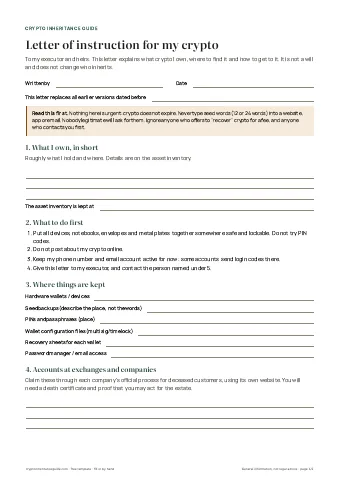
A letter to your executor and heirs: where to start, what not to do, who to call, where the papers and secrets are kept. Two pages. Background: How to write a letter of instruction.
2. Crypto asset inventory
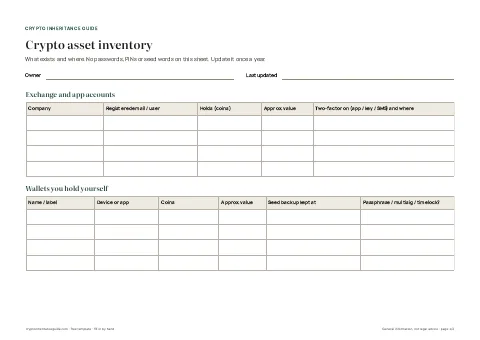
A table of every exchange account, wallet and device, with where each one is and roughly what it holds. No passwords, no seed words. Works for heirs making a list too.
3. Wallet recovery sheet
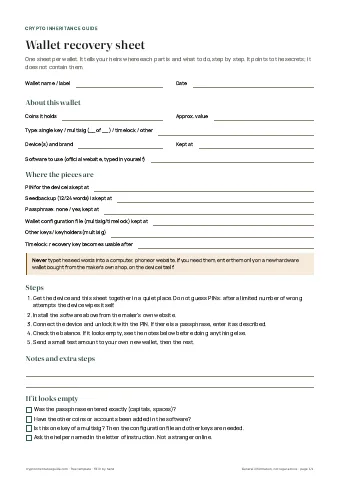
One sheet per wallet: which software and device, where the PIN and seed backup are kept, whether there’s a passphrase, and the steps to move the coins. Written so a non-technical heir can follow it.
4. Keyholder instructions
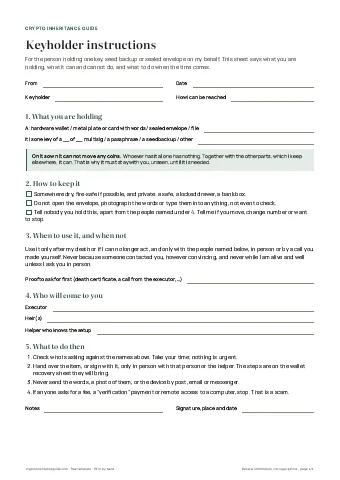
One page for the person who holds a multisig key, a seed backup or a sealed envelope on your behalf: what it is, why it’s useless on its own, how to keep it, who will come for it and what to do then. Background: Multisig inheritance and Where to keep seed phrases.
5. First-steps checklist for heirs
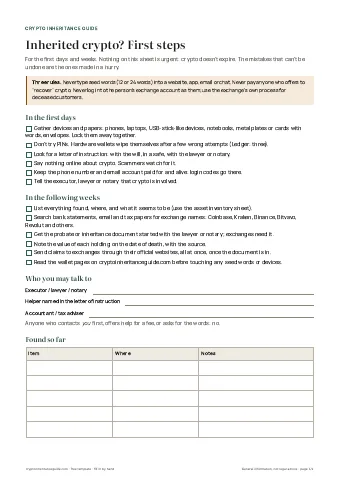
One page to print on the day you find out: secure, don’t guess, don’t post, who to tell, what to collect. The printable version of Your first steps.
6. Sample claim letter to an exchange
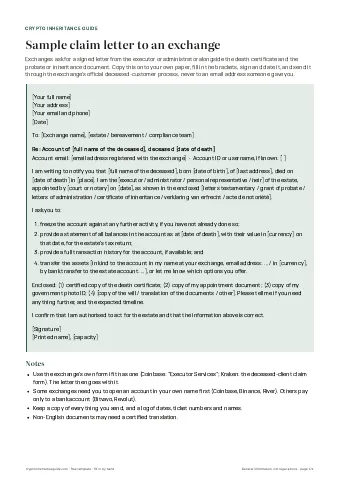
The signed letter exchanges ask for with the death certificate and probate document: who died, who you are, what you’re asking for and where the assets should go, with the enclosures listed. Background: Claiming from an exchange.
How to use them
- Print them. Fill them in with a pen.
- Keep the letter and inventory together, where your executor will look: with your will, or in a known place at home.
- Keep the recovery sheets with the letter, or with each wallet’s backup. They point to the secrets; they don’t contain them. Give the keyholder instructions to each keyholder with the item they’re holding.
- Tell your executor the papers exist and where they are.
- Re-date and update them once a year. See the yearly check-up.
One rule for all six
Don’t write seed words, PINs or passphrases on these sheets unless the sheet itself will be kept as securely as those secrets. The templates have a field for where each secret is kept, not for the secret.
Something missing or unclear? Email [email protected].